


Press release: TfS and CCDTC Complete Joint Study on Mass Balance for Automotive Materials


Press Release
Together for Sustainability and CCDTC Complete Joint Study on Mass Balance for Automotive Materials, Supporting the Efficient and Compliant Adoption of Circular Materials in China’s Automotive Industry
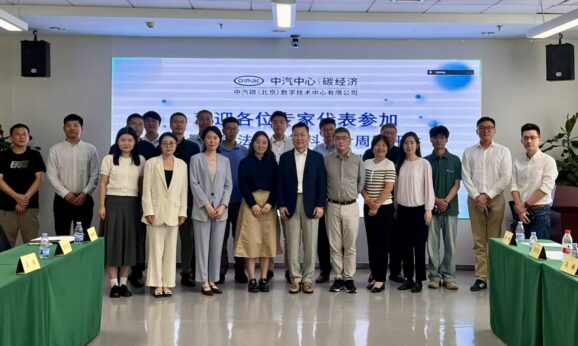
Shanghai, September 9, 2026 – Together for Sustainability (TfS), a leading global initiative advancing sustainability across the chemical supply chain, and CATARC Carbon (Beijing) Digital Technology Center Co., Ltd. (CCDTC), today announced the completion of the first phase of their joint study on Mass Balance for Automotive Materials. The study delivers a modelling methodology and practical implementation guidance for the automotive value chain, helping Chinese automakers adopt circular materials efficiently and compliantly while strengthening sustainable supply chain management.
As the automotive industry accelerates its shift toward defossilisation and a circular economy, demand for circular materials is being driven by both regulation and the market. In Europe, the new End-of-Life Vehicles (ELV) Regulation sets phased targets for recycled plastic content in new vehicles and recognises Mass Balance as a valid method for verifying chemically recycled plastic content. In China, the Extended Producer Responsibility system and the Action Plan for Promoting the Application of Recycled Materials are similarly accelerating uptake. For Chinese automakers—whether exporting to Europe or serving global markets—the ability to demonstrate compliance for recycled materials is becoming increasingly essential.
Mass Balance offers a practical way to meet this challenge. The approach allows alternative and primary fossil-based feedstocks to be processed together on the same production line, then uses rigorous bookkeeping to attribute sustainable/environmental characteristics—such as recycled or bio-derived content—to the final products. Unlike physical segregation, Mass Balance keeps costs down across warehousing, logistics and administration, while ensuring that environmental attributes remain clearly attributed, traceable and auditable. In doing so, it lowers the barrier for companies embarking on their sustainability transition.
The project was led jointly by TfS and CCDTC, which signed a Memorandum of Understanding in September 2025 and carried out the study alongside experts from TfS member companies including Arkema, BASF, Covestro, Evonik and LyondellBasell. The first phase mapped out the methodological framework behind Mass Balance and its applications in automotive plastics, drawing on international standards such as ISO 22095. The work culminated in a research report and an implementation handbook.
The findings show that Mass Balance offers a credible, compliant route for chemically recycled materials to enter mainstream automotive supply chains, with benefits in four key areas. First, it drives the scaled adoption of circular materials, enabling environmental attributes to pass consistently between chemical producers, material suppliers, component makers and automakers. Second, it strengthens closed-loop supply chain management, giving companies better control over material attributes and the underlying chain of evidence through end-to-end recordkeeping. Third, it helps the circular economy move from pilot to scale by reducing the complexity of cross-company collaboration. And fourth, it improves the accuracy and credibility of claims, ensuring Mass Balance attributes are not mistaken for physical content or carbon footprint figures.
“Mass Balance is a vital link between circular feedstocks, material production, customer needs and regulatory compliance,” said Jason Guan, Chair in Duty of TfS China and Head of Raw Material Global Category Management Asia at BASF. “This study shows that our collaboration with CCDTC has moved from shared ambition to real results. Looking ahead, TfS will work with more partners across the automotive value chain to bring Mass Balance into standardised, large-scale use throughout China’s automotive supply chain.”
Wu Jiali, Head of the Low-Carbon Transportation Research Department at CCDTC, said : “Mass Balance offers a pragmatic answer to two persistent problems—recycled origins that are hard to trace, and sustainability claims that are hard to verify. By deepening our work with TfS, we aim to develop solutions suited to China’s automotive industry, helping build a circular economy for the sector.”
Looking ahead, the two organisations will continue their research and industry engagement, encouraging stakeholders across the value chain to build on these findings and helping automotive plastics recycling scale up from early pilots to widespread adoption.
###
About Together for Sustainability
Together for Sustainability (TfS) is a global, procurement-driven initiative created by chemical companies with the goal of assessing, auditing and improving the sustainability practices within their global supply chains. The programme is based on the UN Global Compact and Responsible Care® principles and has grown into a global organisation with regional representation in North and South America and Asia. www.tfs-initiative.com
About CATARC Carbon (Beijing) Digital Technology Center Co., Ltd.
CATARC Carbon (Beijing) Digital Technology Center Co., Ltd. (CCDTC) is a subsidiary of the China Automotive Technology and Research Center (CATARC) Co., Ltd. Established in February 2023 to consolidate CATARC’s expertise and resources in carbon peaking and carbon neutrality (the “dual-carbon” goals), CCDTC serves as CATARC’s dedicated vehicle for advancing its dual-carbon agenda. The company focuses on emerging areas including new energy, dual control of carbon emissions, and the low-carbon economy. Its core business covers carbon value chain databases and algorithm software, carbon budget management, industry- and enterprise-level carbon management platforms, environmental due diligence, ESG assessment, zero- and negative-carbon technologies, and carbon market mechanisms—delivering integrated digital solutions for energy and carbon management. Guided by its motto “Turning Carbon into Value, Growing Together in Harmony,” and anchored in its core values of low-carbon leadership, value creation, ecosystem collaboration and innovation-driven development, CCDTC is committed to advancing industrial carbon neutrality and supporting the sustainable, high-quality development of the manufacturing sector.
Media Contact
Sheena Yuan | APCO
syuan@apcoworldwide.com | +86 166 0196 0415